
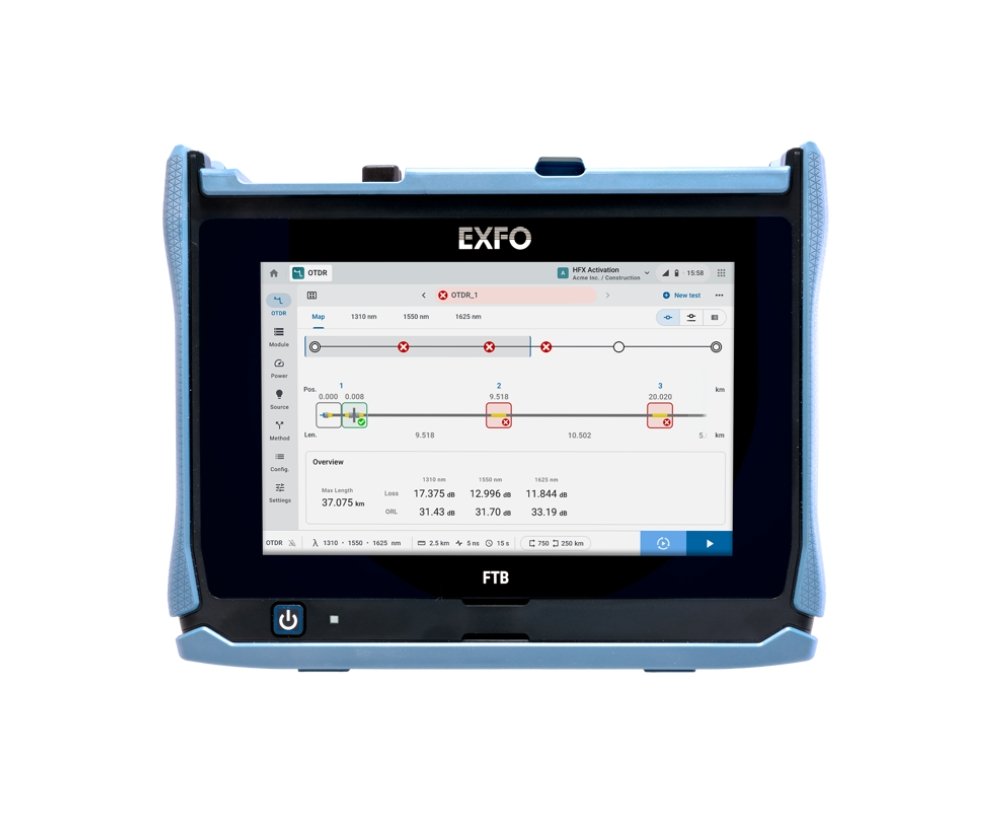
An Optical Time-Domain Reflectometer, commonly called an OTDR, is one of the most important instruments used in fiber optic installation, commissioning and maintenance. It sends light pulses into a fiber and measures the reflected signal to identify loss, splice points, connectors, bends and faults along the link.
Why selecting the right OTDR matters
The right OTDR helps field teams reduce troubleshooting time and produce dependable test reports. A model that does not match the fiber type, network length or required wavelength can lead to incomplete results or unnecessary cost.
Key factors to consider
- Dynamic range: Choose enough range for the total link length, splitters and expected loss.
- Dead zones: Short event and attenuation dead zones are essential for closely spaced connectors and short links.
- Wavelengths: 1310 nm and 1550 nm are common for single-mode fiber; PON and live-fiber applications may require additional wavelengths.
- Fiber type: Confirm whether you need single-mode, multi-mode or a combination module.
- Reporting: Look for onboard reporting and link-map functions that simplify documentation.
- Field usability: Battery life, display brightness, ruggedness and connectivity matter for day-to-day work.
Dynamic range explained
Dynamic range indicates how much loss the OTDR can measure before its trace becomes unusable. Longer backbone links, optical splitters and high-loss networks normally require a greater dynamic range. However, greater range alone is not the only consideration: an instrument with a suitable range and short dead zones is often a better choice for FTTH work.
Recommended approach
Start with the network application. For short FTTH links, prioritize short dead zones and PON-ready wavelengths. For metro or long-haul links, prioritize high dynamic range and flexible pulse settings. Sky Birds International can help you compare OTDR models according to your project requirement.